

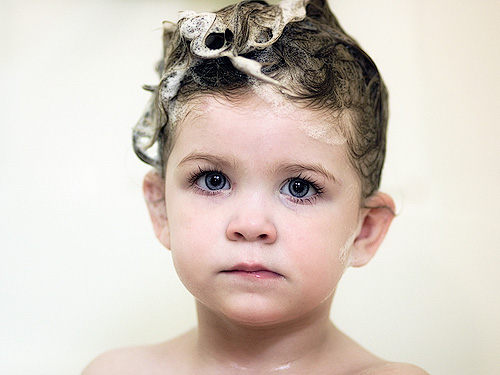
Shampoo
Shampoo (/ʃæmˈpuː/) is a hair care product, typically in the form of a viscous liquid, that is formulated to be used for cleaning (scalp) hair. Less commonly, it is available in solid bar format. ("Dry shampoo" is a separate product.) Shampoo is used by applying it to wet hair, massaging the product in the hair, roots and scalp, and then rinsing it out. Some users may follow a shampooing with the use of hair conditioner.
Shampoo is typically used to remove the unwanted build-up of sebum (natural oils) in the hair without stripping out so much as to make hair unmanageable. Shampoo is generally made by combining a surfactant, most often sodium lauryl sulfate or sodium laureth sulfate, with a co-surfactant, most often cocamidopropyl betaine in water. The sulfate ingredient acts as a surfactant, trapping oils and other contaminants, similarly to soap.
Shampoos are marketed to people with hair. There are also shampoos intended for animals that may contain insecticides or other medications to treat skin conditions or parasite infestations such as fleas.
History
Ancient Mesopotamia
Texts from Akkadian period show that Mesopotamians dealt with a wide range of skin diseases. Their culture emphasized personal hygiene to prevent illness, and there is frequent reference to their use of both medicated and regular soaps and shampoos as methods of prevention and treatment.[1]
Ancient Mesopotamian tablets from the Neo-Assyrian period document the use of medicated shampoo to treat scalp eruptions.[2]
Indian Subcontinent
In India, a variety of herbs and their extracts have been used as shampoos since ancient times. The first origin of shampoo came from the Pre-Harrapans site belonging to the Indus Valley Civilization. A very effective early shampoo was made by boiling Sapindus with dried Indian gooseberry (amla) and a selection of other herbs, using the strained extract.[3][4]
Sapindus, also known as soapberries or soapnuts, a tropical tree widespread in India, is called ksuna (Sanskrit: क्षुण)[5] in ancient Indian texts and its fruit pulp contains saponins which are a natural surfactant. The extract of soapberries creates a lather which Indian texts called phenaka (Sanskrit: फेनक).[6] It leaves the hair soft, shiny and manageable. Other products used for hair cleansing were shikakai (Acacia concinna), hibiscus flowers,[7][8] ritha (Sapindus mukorossi) and arappu (Albizzia amara).[9] Guru Nanak, the founder and the first Guru of Sikhism, made references to soapberry tree and soap in the 16th century.[10]
Cleansing the hair and body massage (champu) during one's daily bath was an indulgence of early colonial traders in India. When they returned to Europe, they introduced the newly learned habits, including the hair treatment they called shampoo.[11] The word shampoo entered the English language from the South Asia during the colonial era.[12] It dated to 1762 and was derived from the Hindi word cā̃pō (चाँपो, pronounced [tʃãːpoː]),[13][14] itself derived from the Sanskrit root chapati (चपति), which means 'to press, knead, or soothe'.[15][16]
Europe

Swedish advertisement for toiletries, 1905/1906
Gauls used soap from goat's fat and beech ash for brightening the hair.[17] Romans made soap from mix of oils and sand. During the 17th century wig-wearing was very popular and cleaning hair with water was discouraged, and instead application of oils was preferred.[17] In the 18th century, the wealthy classes had spas, but as the working class had moved to the cities because of industrialisation, the poor conditions there raised the importance of hygiene.[17]
Sake Dean Mahomed, a Bengali traveller, surgeon, and entrepreneur, is credited with introducing the practice of shampoo or "shampooing" to Britain. In 1814, Mahomed, with his Irish wife Jane Daly, were established as shampooing bathhouse keepers, and a few year laters in 1821 opened the first commercial shampooing vapour masseur bath in England, in Brighton.[18] He described the treatment in a local paper as "The Indian Medicated Vapour Bath (type of Turkish bath), a cure to many diseases and giving full relief when everything fails; particularly Rheumatic and paralytic, gout, stiff joints, old sprains, lame legs, aches and pains in the joints".[19] His 1826 book on shampooing featured testimonies from his patients, as well as the details of the treatment made him famous. The book acted as a marketing tool for his unique baths in Brighton and capitalised on the early 19th-century trend for seaside spa treatments.[20]
Meaning "wash the hair" of shampoo was first recorded in 1860.[16] During the early stages of shampoo in Europe, English hair stylists boiled shaved soap in water and added herbs to give the hair shine and fragrance. Commercially made shampoo was available from the turn of the 20th century. A 1914 advertisement for Canthrox Shampoo in American Magazine showed young women at camp washing their hair with Canthrox in a lake; magazine advertisements in 1914 by Rexall featured Harmony Hair Beautifier and Shampoo.[21]
In 1900, German perfumer and hair-stylist Josef Wilhelm Rausch developed the first liquid hair washing soap and named it "Champooing" in Emmishofen, Switzerland. Later, in 1919, J.W. Rausch developed an antiseptic chamomile shampooing with a pH of 8.5.[22]
In 1927, liquid shampoo was improved for mass production by German inventor Hans Schwarzkopf in Berlin; his name became a shampoo brand sold in Europe.
Originally, soap and shampoo were very similar products; both containing the same naturally derived surfactants, a type of detergent. Modern shampoo as it is known today was first introduced in the 1930s with Drene, the first shampoo using synthetic surfactants instead of soap.
Indonesia
Early shampoos used in Indonesia were made from the husk and straw (merang) of rice. The husks and straws were burned into ash, and the ashes (which have alkaline properties) are mixed with water to form lather. The ashes and lather were scrubbed into the hair and rinsed out, leaving the hair clean, but very dry. Afterwards, coconut oil was applied to the hair in order to moisturize it.[23]
Philippines
Filipinos have been traditionally using gugo before commercial shampoos were sold in stores. The shampoo is obtained by soaking and rubbing the bark of the vine Gugo (Entada phaseoloides),[24][25] producing a lather that cleanses the scalp effectively. Gugo is also used as an ingredient in hair tonics.[26]
Pre-Columbian North America
Certain Native American tribes used extracts from North American plants as hair shampoo; for example the Costanoans of present-day coastal California used extracts from the coastal woodfern, Dryopteris expansa.[27]
Pre-Columbian South America
Before quinoa can be eaten the saponin must be washed out from the grain prior to cooking. Pre-Columbian Andean civilizations used this soapy by-product as a shampoo.[28]
Types
Shampoos can be classified into four main categories:[29]
- deep cleansing shampoos, sometimes marketed under descriptions such as volumizing, clarifying, balancing, oil control, or thickening, which have a slightly higher amount of detergent and create a lot of foam;
- conditioning shampoos, sometimes marketed under descriptions such as moisturizing, 2-in-1, smoothing, anti-frizz, color care, and hydrating, which contain an ingredient like silicone or polyquaternium-10 to smooth the hair;
- baby shampoos, sometimes marketed as tear-free, which contain less detergent and produce less foam;
- anti-dandruff shampoos, which are medicated to reduce dandruff.[29]
Composition

Typical liquid shampoo
Shampoo is generally made by combining a surfactant, most often sodium lauryl sulfate or sodium laureth sulfate, with a co-surfactant, most often cocamidopropyl betaine in water to form a thick, viscous liquid. Other essential ingredients include salt (sodium chloride), which is used to adjust the viscosity, a preservative and fragrance.[30][31] Other ingredients are generally included in shampoo formulations to maximize the following qualities:
- pleasing foam
- ease of rinsing
- minimal skin and eye irritation
- thick or creamy feeling
- pleasant fragrance[32]
- low toxicity
- good biodegradability
- slight acidity (pH less than 7)
- no damage to hair
- repair of damage already done to hair
Many shampoos are pearlescent. This effect is achieved by the addition of tiny flakes of suitable materials, e.g. glycol distearate, chemically derived from stearic acid, which may have either animal or vegetable origins. Glycol distearate is a wax. Many shampoos also include silicone to provide conditioning benefits.